


It is no accident that monastic life is the location and model of unguarded intimacy with Christ through the Song [of Songs] and, in turn, through the rest of Scripture. In the lives of monks and nuns—those we later come to call mystics—we come to see that Scripture is not primarily a didactic, discursive, or scholarly text. It is a spiritual book for spiritual persons: those given to know the mind of the Spirit of God (cf. 1 Cor 2:6-16). The way to know Scripture, therefore, is one and the same as the way to know the Song: saturation, meditation, solitude, silence. Spiritual exegesis, in other words. For in the case of the Song, there is no proposition waiting at the end of the interpretive task, no doctrinal payoff. It is just the Lord. The ecstasy of contemplation is finding him—finding him—and delighting in nothing else. In this way the faithful reader of the Song exemplifies faithful reading of Scripture as a whole: defined, from beginning to end, by the acclamation, the exultation, the unashamed exclamation: “Whom have I in heaven but you? And there is nothing upon earth that I desire besides you. My flesh and my heart may fail, but God is the rock of my heart and my portion forever” (Ps 73:25-26).
Brad makes a very interesting point here about monastic (mystical) interpretation of the Song of Songs and, by extension, the rest of Scripture. He thinks that monks and nuns were on to something in reading the Bible in the mode of the Song—a mode of reading oriented toward intimacy and delight rather than rational apprehension or what have you. What I find fascinating, though, is this: It seems that this ‘monastic’ style of reading shares some overlapping concerns with the so-called “theological interpretation of Scripture” (TIS) movement. TIS proponents are often fed up with the inherited scholarly ways of reading Scripture (e.g., didactic, discursive) that fail to arrive at where Scripture means to take its readers (i.e., communion with God). However, and this is what I find especially interesting, the theological interpretation movement is an academic trend being carried out by scholars. Which makes me wonder if it will ever, in actual practice, lead to the kind of spiritual exegesis of the mystics that Brad commends here. For, as he points out, the means for this kind of reading are: saturation, meditation, solitude, and silence. It seems to me that the monastery provided a certain habitus that was uniquely suited to the interpretive ends that these readers were pursuing. As well-intentioned as the TIS movement is, and as much as I resonate with its critiques of grammatical-historical exegesis, its practitioners are not well-positioned to arrive at the same end. Perhaps this is where we once more seek to “re-imagine” theological education in the vein of Bonhoeffer at Finkenwalde.
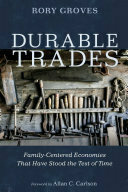
Finished reading: Durable Trades by Rory Groves 📚
Durable Trades is the needed cure for what Graeber described as Bullshit Jobs. Groves' narrative in the early chapters is a familiar one: The Industrial Revolution uprooted work from the home, created ever-more-specialized jobs to increase efficiency, and, as a result, has basically banished all thought of self-sufficiency from our minds. The majority of Groves' book, however, explores what he calls “durable trades”—roughly sixty or so trades that have withstood technological disruption and cultural change, even as they’ve morphed in all sorts of ways over the centuries. Groves scores each trade using five categories: historical stability, resiliency, family-centeredness, income, and ease of entry. A useful and eye-opening book.
The fact is, our perceptions about trades and the people who work in them are mostly false. Uncomfortable as it may be, there is more money, intelligence, creativity and flexibility involved in trades than in most white-collar jobs. Many trades are more conducive to family life than demanding, high-powered corporate jobs. Most tradesmen do not need to travel far to find work; there is plenty of demand locally. And trades…are not as likely to become displaced by the next autonomous robot or software upgrade. They have stood the test of time and, in all likelihood, will continue to do so.
Scripture is…a book for the mission, a portable library of trustworthy samples of gospel speech. Whatever the church in its ongoing encounters with new questions, challenges, and cultures elects to say in its attempt to announce the gospel, such attempts must be tested by the records contained in the New Testament. Moreover, those records are themselves missionary documents: in media res, they offer neither a blank slate upon which to construct the gospel nor a final word definitively closing this or that matter. They are experiments in improvisation on the way from Pentecost to parousia. Gentiles are coming to faith, women are prophesying with heads uncovered, ex-pagans are eating idol meat, traveling teachers are suggesting Jesus didn’t come in the flesh, scoffers are claiming Jesus isn’t coming back, others are saying he’s already returned, Jewish apostles aren’t eating with gentile believers, a church member is sleeping with his stepmother: what to do? These aren’t perennial issues in philosophy, and the apostolic writings are not treatises in systematic theology. They are makeshift answers, sometimes on the fly, to pressing questions of lived faith. That haphazard character may be a thorn in the flesh of theologians, but it is a boon to the church’s life among the nations. For what it offers is not timeless answers but snapshots of the apostles in action, a model for discernment of the Spirit in real time. And when further questions arise—Should we worship Jesus? Is Mary God’s mother? May icons be venerated? Is the Spirit fully God?—the church turns to Scripture not only for divine instruction but for exemplary patterns of sound judgment exercised on the mission field and captured, in the moment, for future generations of believers.
George Macdonald (HT: Alan Jacobs):
Instead of asking yourself whether you believe or not, ask yourself whether you have this day done one thing because He said, Do it, or once abstained because He said, Do not do it. It is simply absurd to say you believe, or even want to believe, in Him, if you do not do anything He tells you.
from the cover of Brad East’s book



Currently reading: The History of the Ancient World: From the Earliest Accounts to the Fall of Rome by Susan Wise Bauer 📚