
Here’s a map of the fictionalized town of Winesburg (Wikimedia):
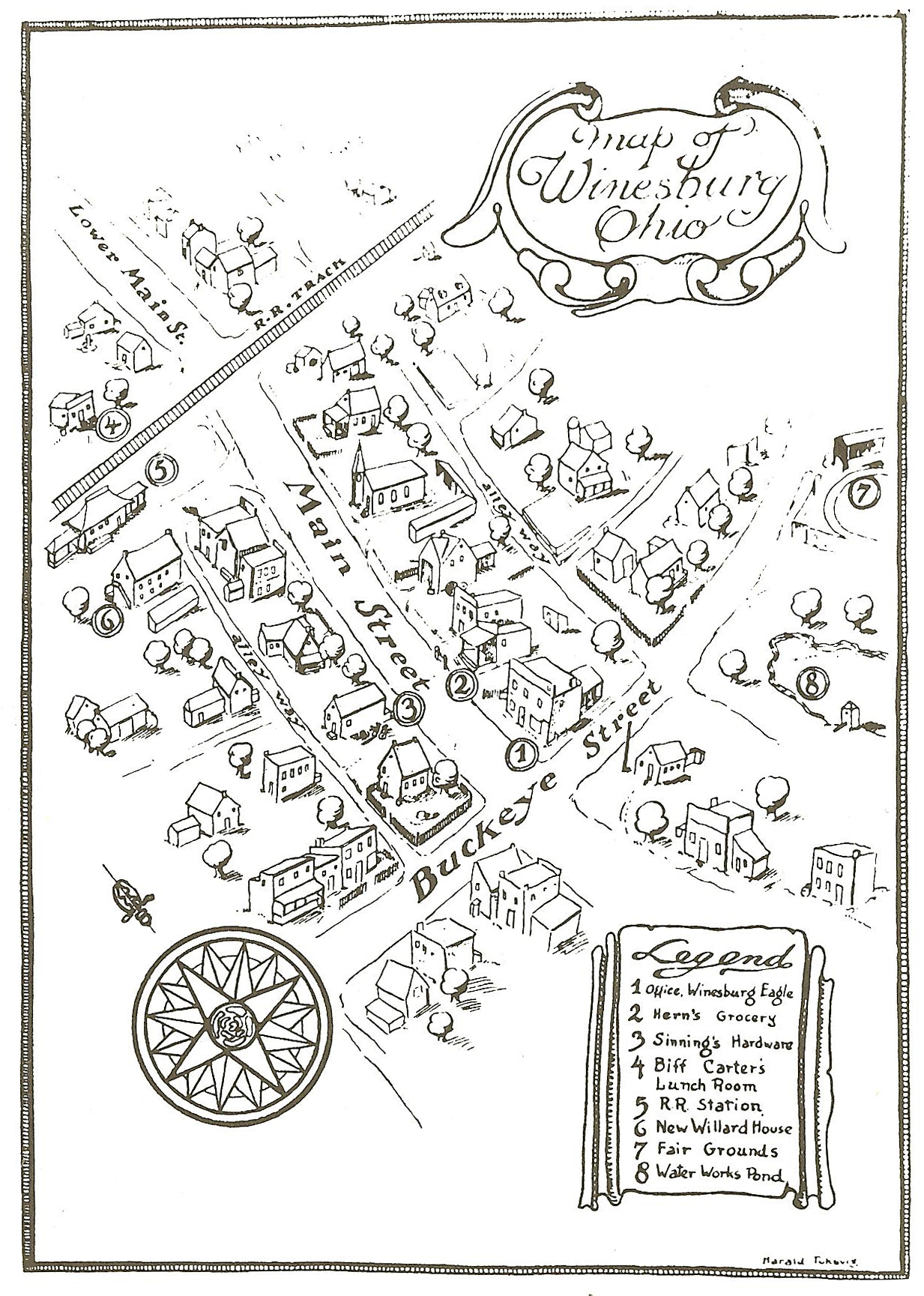
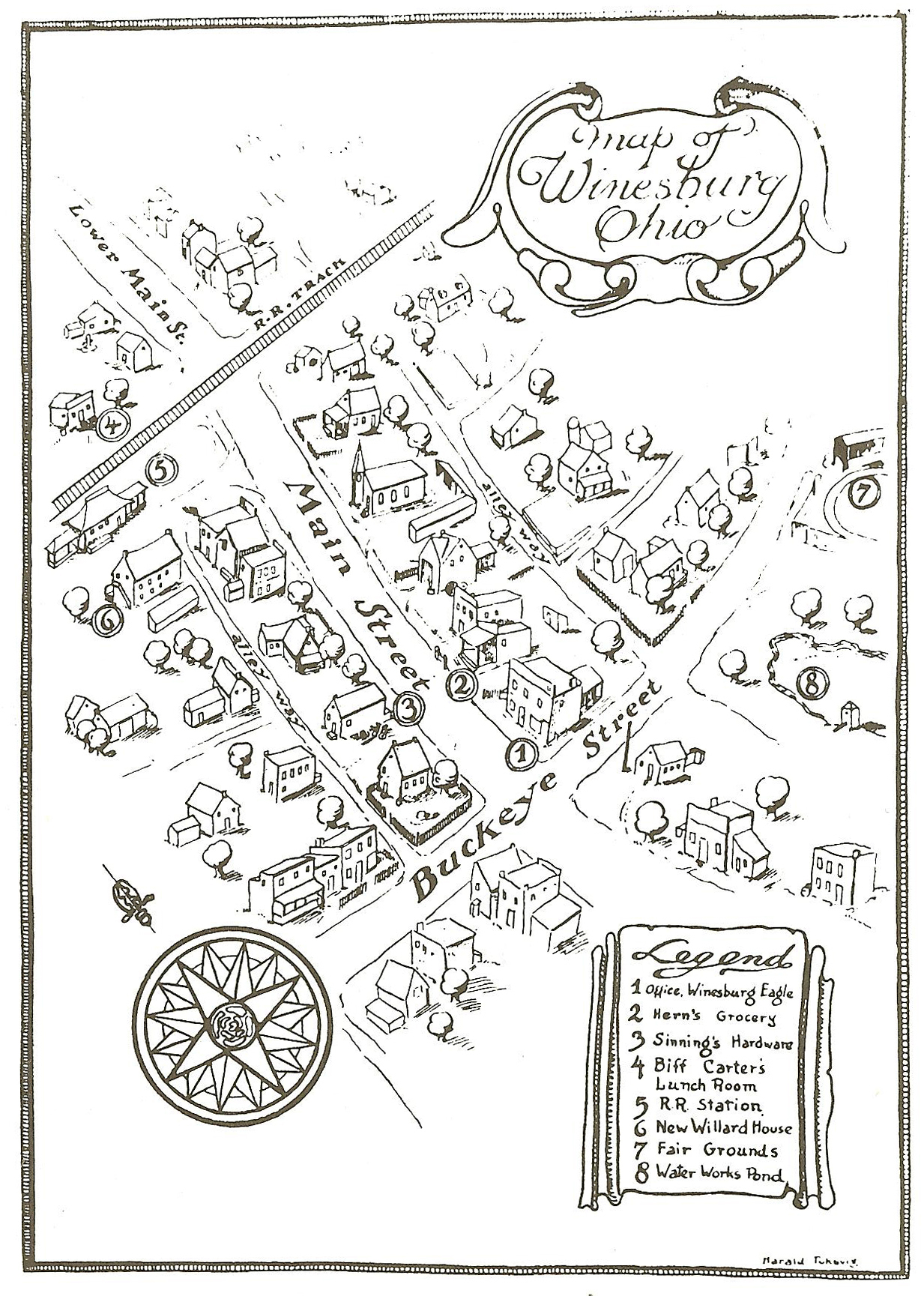
Here’s a map of the fictionalized town of Winesburg (Wikimedia):
I need to return to Sherwood Anderson’s Winesburg, Ohio, a collection of stories centered around the small fictionalized town of Winesburg. I’d love to snag this copy in particular:


When we merely say that we are bad, the ‘wrath’ of God seems a barbarous doctrine; as soon as we perceive our badness, it appears inevitable, a mere corollary from God’s goodness. To keep ever before us the insight derived from such a moment [of perceiving one’s own sin], to learn to detect the same real inexcusable corruption under more and more of its complex disguises, is therefore indispensable to a real understanding of the Christian faith. This is not, of course, a new doctrine. I am attempting nothing very splendid…. I am merely trying to get my reader (and, still more, myself) over a pons asinorum—to take the first step out of fools' paradise and utter illusion.
As Lewis says, this insight really is indispensable to a real understanding of the Christian faith. I’m more convinced of this every day. I also suspect, sadly, that many Christians never take the first step out of fool’s paradise and utter illusion. Maturity in the Christian life consists, in great measure, in progressively realizing how deep the rabbit hole of one’s own sin goes. Spiritual growth is not always, or even often, particularly glamorous. Lewis is spot on: It’s often detecting corruption under layers of rationalization, buried even from one’s own self by “complex disguises.” To unmask and uncover all this, painful and humbling though it may be, is the Christian path to joy and freedom.
Beware lest you are making use of the idea of corporate guilt to distract your attention from those humdrum, old-fashioned guilts of your own which have nothing to do with ‘the system’ and which can be dealt with without waiting for the millennium. For corporate guilt perhaps cannot be, and certainly is not, felt with the same force as personal guilt. For most of us, as we now are, this conception is a mere excuse for evading the real issue. When we have really learned to know our individual corruption, then indeed we can go on to think of the corporate guilt and can hardly think of it too much. But we must learn to walk before we run.
Characteristically wise words from Lewis; they certainly have renewed force in our day. The one point I would want to push on is his assertion that “corporate guilt perhaps cannot be, and certainly is not, felt with the same force as personal guilt.” He seems confident that corporate guilt was not felt with the same force as personal guilt in his day (“certainly is not”). He seems less sure—signalled by the “perhaps cannot be”—that corporate guilt could never be felt with the same force as personal guilt. It seems to me quite plausible that plenty of people in our culture do experience corporate guilt with much more force than any feeling of personal guilt. But, if anything, this would only strengthen what Lewis says here. He’s arguing that there’s a progression that ought to take place here (e.g., walking before running; making your own bed before rallying to overturn the bourgeois expectations of well-kept sleeping quarters). So, if our society feels the force of corporate guilt more strongly than personal guilt, this suggests not an impossibility but a reversal of the proper order. We’ve been trained to feel more revulsion at societal ills than at our own moral failings. Such moral sentiments are certainly appropriate (Lewis says as much), but only after we’ve honed them with the small stuff. We should not despise the day of small things.
From our own childhood we remember that before our elders thought us capable of ‘understanding’ anything, we already had spiritual experience as pure and as momentous as any we have undergone since, though not, of course, as rich in factual context. From Christianity itself we learn that there is a level—in the long run the only level of importance—on which the learned and the adult have no advantage at all over the simple and the child.

it’s time to repave

How do I say bye to that face?


