



Finished reading: Dietrich Bonhoeffer Works, Vol. 5: Life Together and Prayerbook of the Bible by Dietrich Bonhoeffer 📚
Life Together, though historically recent, still deserves a spot among the classics of Christian spirituality. Certainly it is one that should be revisited often, even yearly.
Dietrich Bonhoeffer, on how learning to curb our evil words about others in the Christian community (which really are just the outward expression of evil thoughts) leads to an entirely changed outlook on our fellow image-bearers:
Where this discipline of the tongue is practiced right from the start, individuals will make an amazing discovery. They will be able to stop constantly keeping an eye on others, judging them, condemning them, and putting them in their places and thus doing violence to them. They can now allow other Christians to live freely, just as God has brought them face to face with each other. The view of such persons expands and, to their amazement, they recognize for the first time the richness of God’s creative glory shining over their brothers and sisters. God did not make others as I would have made them. God did not give them to me so that I could dominate and control them, but so that I might find the Creator by means of them. Now other people, in the freedom with which they were created, become an occasion for me to rejoice, whereas before they were only a nuisance and trouble for me. God does not want me to mold others into the image that seems good to me, that is, into my own image. Instead, in their freedom from me God made other people in God’s own image. I can never know in advance how God’s image should appear in others. That image always takes on a completely new and unique form whose origin is found solely in God’s free and sovereign act of creation. To me that form may seem strange, even ungodly. But God creates every person in the image of God’s Son, the Crucified, and this image, likewise, certainly looked strange and ungodly to me before I grasped it.

Finished reading: The Problem of Pain by C. S. Lewis 📚
With each Lewis book I finish, my awe at what he was able to accomplish only increases.
[W]e are afraid that heaven is a bribe, and that if we make it our goal we shall no longer be disinterested. It is not so. Heaven offers nothing that a mercenary soul can desire. It is safe to tell the pure in heart that they shall see God, for only the pure in heart want to. There are rewards that do not sully motives. A man’s love for a woman is not mercenary because he wants to marry her, nor his love for poetry mercenary because he wants to read it, nor his love of exercise less disinterested because he wants to run and leap and walk. Love, by definition, seeks to enjoy its object.
John Webster, on theological criticism as an activity performed by and for the Christian community:
There are no infallible methods of theological criticism, though there are some pretty well-tested ones which we ignore at our peril, such as exegetical or creedal fidelity. What is crucial is that criticism be seen as a spiritual transaction which cannot be codified or made into a routine. Christian theological criticism requires of its practitioners the same skills as any other kind of theology, because it is simply Christian theology about the business of appraisal rather than description. It requires the same attentiveness, the same self-distrust, the same readiness for fresh conversion, above all, the same prayer for the coming of the Holy Spirit to disable the dullness of our blinded sight. Critical theology is thus a mode of reflective attention to the gospel, one which directs that attention to the possible fissures between the gospel and our inhabitation of it. Therein, it simply reiterates God’s repudiation of our idolatries.
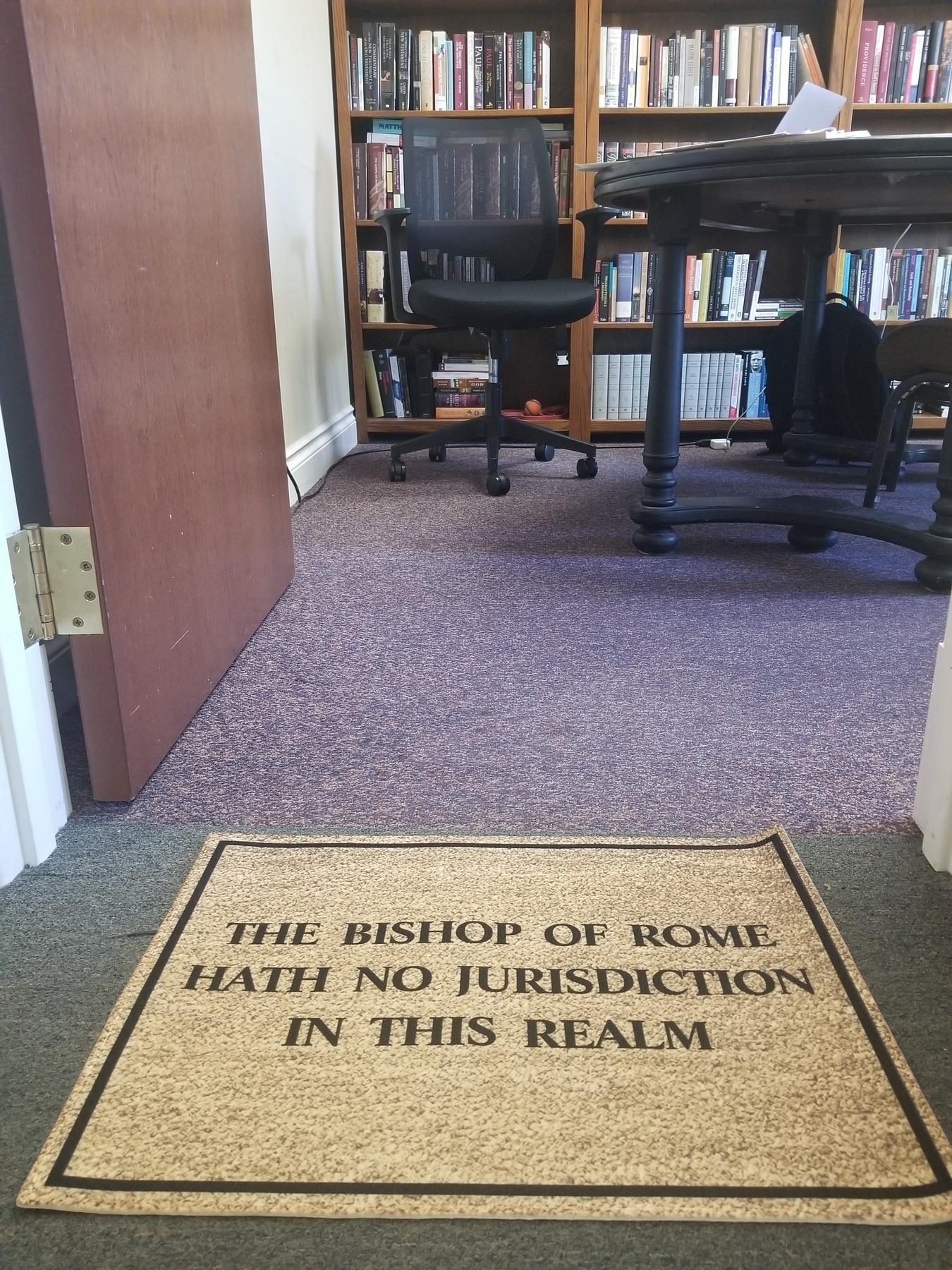
my new office doormat, courtesy of the Davenant Institute
As I embark on a self-directed course of study in art history, the natural place to begin is the Stone Age. Paintings from the Paleolithic era are more impressive than I remembered. Looking at ancient artwork (and reading ancient history for that matter), I’m struck more by the continuity between us moderns and those distant ancestors than any of the (seemingly great, but really quite superficial) differences. These paintings from the Lascaux Cave in France are particularly striking (Wikipedia).


C. S. Lewis, on (gulp) hell:
There is no doctrine which I would more willingly remove from Christianity than this, if it lay in my power. But it has the full support of Scripture and, specially, of Our Lord’s own words; it has always been held by Christendom; and it has the support of reason. If a game is played, it must be possible to lose it. If the happiness of a creature lies in self-surrender, no one can make that surrender but himself (though many can help him to make it) and he may refuse. I would pay any price to be able to say truthfully ‘All will be saved.’ But my reason retorts ‘Without their will, or with it?’ If I say ‘Without their will’ I at once perceive a contradiction; how can the supreme voluntary act of self-surrender be involuntary? If I say ‘With their will,’ my reason replies ‘How if they will not give in?’